Learning Objectives
Review the available data regarding choice and duration of anticoagulation to prevent recurrent thrombosis in polycythemia vera
Discuss the available data regarding cytoreductive agents and their efficacy for secondary thrombosis prevention in polycythemia vera
CLINICAL CASE
A 50-year-old woman develops a right femoral deep vein thrombosis. Laboratory results reveal a hemoglobin of 17 g/dL, hematocrit of 50%, platelet count 560 K/µL, and erythropoietin level of 1.5 IU/L. Molecular testing reveals a JAK2 V617F mutation with a variant allele frequency (VAF) of 60%. Additional hypercoagulable workup is negative.
Introduction
Polycythemia vera (PV), one of the myeloproliferative neoplasms (MPNs), is a clonal hematologic malignancy characterized by activating mutations in JAK2. Approximately 95% of patients with PV have mutations in either Janus kinase 2 (JAK2) V617F or exon 12 resulting in excess erythropoiesis, increased red blood cell mass, and aberrant cytokine signaling.1 The leading cause of morbidity and mortality in PV is thrombosis, including arterial and venous thrombosis, both at usual and unusual sites. The rate of VTE is highest during the first 3 months after diagnosis, with a nearly 10-fold increase during this period.2,3 While the VTE risk decreases over time, it remains significantly higher than the risk in the general population.2,4 Current treatments aim to mitigate the risks of arterial and venous thrombosis. However, there is no consensus regarding the optimal regimen. Here we will focus on secondary prevention after usual site VTE.
Risk factors
Thrombosis is an independent risk factor for survival in PV.1 Age >65 years, prior history of VTE, leukocytosis, and co-occurrence of inherited thrombophilias are predictors of recurrent events.5-7 The presence of a JAK2V617 mutation is a known risk factor for both arterial and venous thrombosis; however, only VTEs have been independently correlated with the JAK2 allele burden.8 In patients with a VAF ≥50%, the incidence of thrombosis is 4.6 times higher than in patients with a VAF <50%.8
Pathogenesis of thrombosis
The pathogenesis of thrombosis in PV is multifactorial and highlights the complexity involved in developing effective treatment strategies. Systemic inflammation stemming from dysregulated cytokine signaling combined with increased circulating JAK2 clonal cells and acquired prothrombotic and adhesive properties in mutant PV cells create a thromboinflammatory state.1,3 Circulating, activated platelets demonstrate increased expression of P-selectin and tissue factor and show enhanced aggregation with adenosine diphosphate and thrombin generation.3 Hyperviscosity ensues from enhanced erythropoiesis and, under high shear rates, increased red blood cell mass displaces platelets toward the vessel lumen, causing shear-induced platelet activation.5,8 Platelet and red blood cell aggregates further impede laminar blood flow.5 Activated neutrophils in PV release extracellular DNA traps, activating platelets and enhancing aggregation.1 Abnormal endothelial expression of adhesion receptors facilitate platelet, red blood cell, and leukocyte binding to the vessel lumen.1 Cytokine-mediated upregulation of P-selectin and von Willebrand factor expression in JAK2-mutated endothelial cells, enhanced protein S and C resistance, and increased procoagulant microparticles may also contribute to thrombotic risk.1,5,8
Secondary prevention
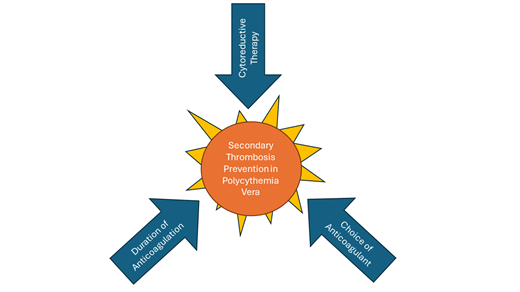
Secondary VTE prevention in PV includes anticoagulation (AC) and chemical cytoreduction. However, the optimal regimen and duration remains unclear.
Duration of anticoagulation
Although there is a high rate of recurrent VTE, the duration of AC for secondary prophylaxis has to be balanced against the increased risk of bleeding that coexists in this patient population (Table 1).2,4 Data evaluating the benefits of long-term AC are retrospective. A study of 206 patients with MPN-related VTE demonstrated that risk of recurrence among patients who continued vitamin K antagonists (VKAs) long-term was reduced significantly (5.3 versus 12.8 per 100 patient-years in those who discontinued AC).9 An earlier study of 494 patients with PV or essential thrombocythemia (ET) revealed that long term AC (primarily VKAs) and long-term antiplatelet therapy (APT) reduced the risk of a second thrombosis by 68% and 58%, respectively.4 Hernández-Boluda et al (N = 150) reported similar results10 (Table 1). Bleeding was not statistically greater in patients continuing long-term AC unless APT therapy was also continued4,9,10 (Table 1). In unprovoked VTEs, reduced-dose direct oral anticoagulants (DOACs) have demonstrated efficacy in the prevention of secondary VTEs; however, this approach has not been rigorously validated either in cancer associated thrombosis (CAT) or, specifically, MPN-associated thrombosis.11
Choice of anticoagulant
The optimal choice of anticoagulant for PV-associated thrombosis has yet to be elucidated. Unique thrombotic mechanisms in PV may preclude direct extrapolation of these findings in the general CAT literature. In a systemic review of 10 observational studies (N = 1295), Hamulyák et al found higher rates of recurrent thrombosis among MPN patients receiving only VKA versus DOACs (no cytoreduction).12 Two smaller retrospective studies evaluating recurrence risk in 71 and 30 patients with MPN-related VTE found no long-term difference in recurrence rate between VKAs and DOACs.13,14 Huenerbein et al (N = 70) did find a higher recurrent thrombosis frequency among patients receiving VKAs (P = 0.0003) despite similarities in thrombosis-free survival (P = 0.2).13Table 2 summarizes the findings as well as comparisons of bleeding risk. Aspirin demonstrated efficacy in primary prevention of arterial thrombosis and cardiovascular events in the landmark European Collaboration on Low-Dose Aspirin in PV (ECLAP) study.15 There was no statistically significant difference seen versus placebo in prevention of VTE, specifically.15 Retrospective reviews have suggested APT may have some efficacy in secondary VTE prevention.4 However, the bleeding risk may be increased.
Cytoreductive therapy
Cytoreductive therapy in PV is implemented to normalize the blood counts and mitigate both thrombotic risk and symptom burden. It is an essential component of secondary thrombosis prevention in MPNs.16 The current hematocrit goal in PV of < 45% was associated with a 4-fold lower risk of vascular events compared to a more liberal target of 45%-50%; however, there was no difference in the rate VTE.17 The systematic review by Hamulyák et al demonstrated that the risk of recurrent VTE was lower in patients receiving oral AC in combination with cytoreductive therapy than those receiving AC, APT, or cytoreductive therapy alone.12 Although the currently approved cytoreductive therapies are able to achieve a hematologic response, they have differing antithrombotic capabilities. Hydroxyurea causes pan-myelosuppression, decreased expression of endothelial adhesion molecules, and increased nitric oxide generation.18 It has demonstrated greater efficacy than phlebotomy in reducing arterial thrombosis in high-risk patients but not in reducing VTE risk.17 Ruxolitinib, a selective inhibitor of JAK kinase activity, did not initially decrease thrombosis risk among PV patients in randomized trials.8,19 However, in the more recent MAJIC-PV trial, which included 180 hydroxyurea intolerant/resistant patients with PV, ruxolitinib demonstrated improved thromboembolic event free survival (hazard ratio, 0.56; 95% CI, 0.32-1.0; P = .05) vs best available therapy (BAT).20 Additionally, achievement of a major molecular response (defined as a 50% reduction in the JAK2 V617F allele burden) was associated with improved progression-free survival (P = 0.001), event-free survival (P = 0.006), and overall survival (P = 0.04) in patients receiving ruxolitinib but not BAT.20 Of note, this study enrolled high risk PV patients with and without a prior thrombosis.20 The PROUD-PV (phase 3 RCT) and CONTINUATION PV (extension) trials evaluating ropeginterferon-alfa-2b-Njft vs BAT did not demonstrate a difference in thrombotic events, but number of thrombotic events was small.21 Single arm trials with interferon have demonstrated efficacy.5 Both ruxolitinib and ropeginterferon-alfa-2b-njft have demonstrated sustained reductions in the JAK2 V617F allele burden, which were associated with improved hematologic response compared to hydroxyurea.8
Recommendations
PV patients who develop a VTE should receive therapeutic AC and chemical cytoreductive therapy with the goal of maintaining a hematocrit <45%. Strong recommendation, moderate quality evidence.
PV patients who develop a VTE should receive indefinite AC with a VKA or DOAC if bleeding risk is not prohibitive. Strong recommendation, low quality evidence.
Given its highly associated bleeding risk, the continuation of APT in patients receiving therapeutic AC for VTE should be reserved for patients with a high risk of arterial events. Weak recommendation, low quality evidence.
Future directions
The incidence of recurrent VTE in MPNs remains high despite available therapies.9 Risk-adapted scoring systems are needed that integrate the patient- and disease-specific risk factors for thrombosis and bleeding that occur in individual MPN diagnoses. Clinical trials evaluating the safest and most effective combinations of approved and novel (eg, BET inhibitors, hepcidin mimetics) cytoreductive agents with known or novel antithrombotic therapies (eg, direct thrombin or factor XI inhibitors) are needed. As JAK2 allele burden evolves as a treatment milestone in PV, molecular response may someday provide an opportunity to discontinue long-term anticoagulation.
CLINICAL CASE (continued)
The patient received phlebotomy, therapeutic apixaban, and ropeginterferon-alfa-2b-njft, resulting in the normalization of her hematocrit. Aspirin was discontinued. She has had no subsequent thrombotic or bleeding events. Subsequent testing after 36 months of therapy revealed a reduction of the JAK2 VAF to 30%. Additional data are needed to determine if AC may someday be stopped pending further molecular response.
Conflict-of-interest disclosure
Helen Ajufo: no competing financial interests to declare.
Jennifer Vaughn: Incyte Advisory Board.
Off-label drug use
Helen Ajufo: Nothing to disclose.
Jennifer Vaughn: Nothing to disclose.